

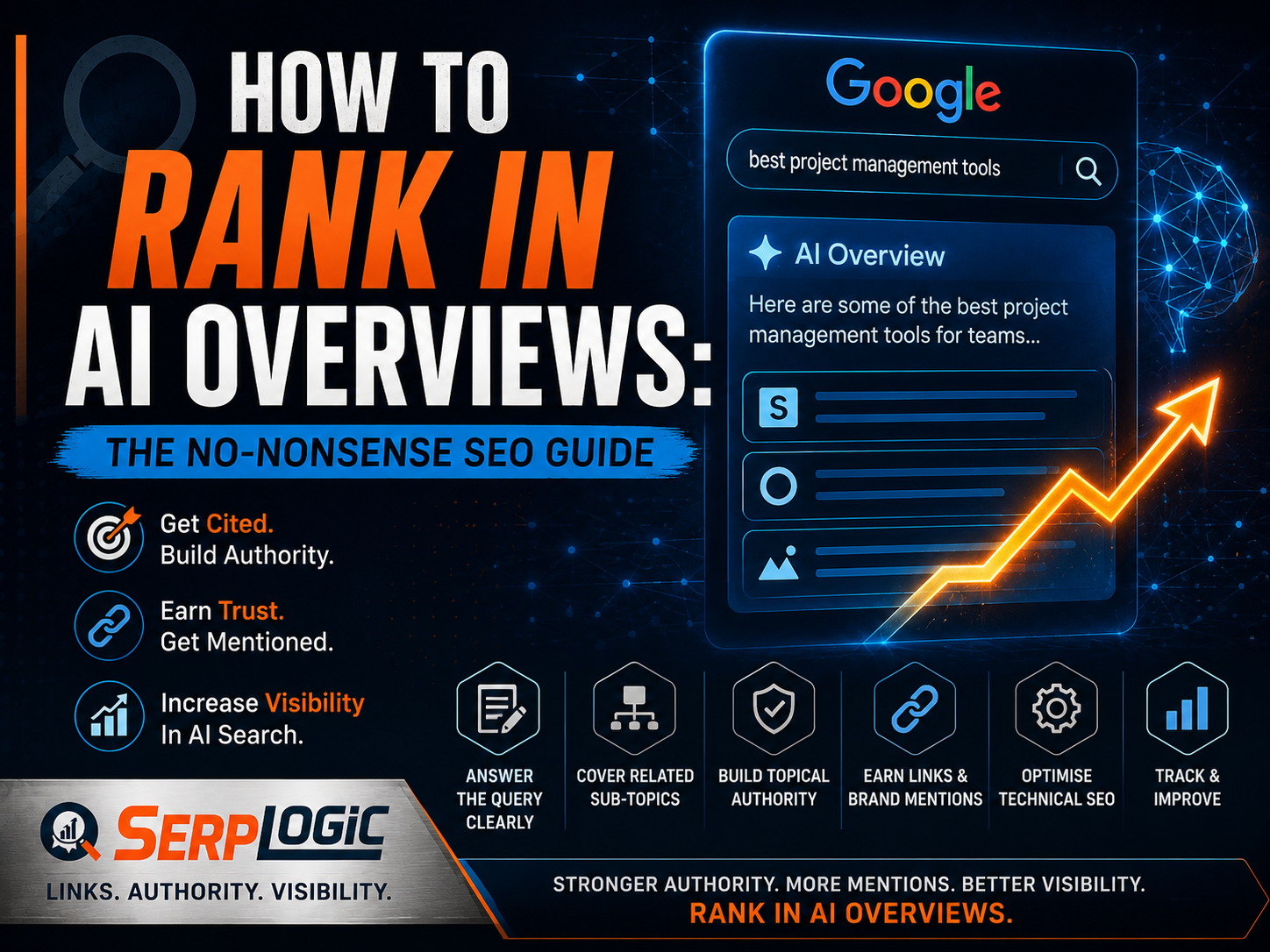
Everyone wants to rank in AI Overviews now.
Which is funny, because most people still have not sorted the basics that made them rank in normal Google in the first place.
Their content is thin. Their brand is vague. Their internal links are a mess. Their site has no authority. Nobody credible mentions them. Then they wonder why Google’s AI-generated results are not falling over themselves to cite them.
Let’s be clear from the start.
You do not “rank” in AI Overviews the same way you rank in the normal organic results.
You get selected, cited, surfaced or used as a supporting source when Google decides your content helps answer the query.
That distinction matters.
Because if you treat AI Overviews like a new ranking slot that can be gamed with a few tricks, you are probably going to waste a lot of time.
If you treat them as another layer of search visibility built on relevance, trust, clarity, authority and usefulness, you have a much better shot.
This is not magic.
It is SEO with a new surface area.
What Are AI Overviews?
AI Overviews are Google’s AI-generated summaries that appear for some searches.
Instead of only showing a list of blue links, Google may generate a summary that answers the query, pulls together information from multiple sources, and includes links where users can dig deeper.
For users, that can make research faster.
For site owners, it changes the visibility game.
If your content appears as a supporting source, you get exposure in a very prominent part of the search results.
If your competitors appear and you do not, they may earn trust before the user even scrolls.
That is why AI Overview visibility matters.
Not because organic SEO is dead.
Because the SERP has more surfaces now.
Can You Actually Rank in AI Overviews?
Not in the traditional sense.
You rank in organic search results.
In AI Overviews, your content may be selected as a useful source, cited as supporting material, or used to help generate the answer.
That means the better question is not:
“How do I rank number one in AI Overviews?”
The better question is:
“How do I make my content and brand more likely to be trusted by Google’s AI search systems?”
That is where the real work starts.
And no, the answer is not “add more AI keywords”.
How Google AI Overviews Choose Sources
Nobody outside Google knows the full source selection process.
Anyone pretending they have the complete formula is selling smoke.
But from an SEO perspective, the likely ingredients are not mysterious.
Google needs sources that are:
- crawlable
- indexable
- relevant
- useful
- clear
- trustworthy
- topically aligned
- supported by authority signals
- good enough to help answer the query
In other words, the same kind of signals that already mattered in SEO still matter.
The difference is how the information gets surfaced.
Instead of only trying to win a normal organic result, you are trying to become part of Google’s generated answer.
That means your content needs to be more than present.
It needs to be useful enough to extract, trust and cite.
Why Normal SEO Still Matters
This is where most AI SEO advice goes off the rails.
People talk about Google AI Overviews as if they are a separate universe.
They are not.
If your page cannot be crawled, indexed or trusted in normal Google, it is unlikely to perform brilliantly in AI search either.
Before chasing AI Overview visibility, sort the basics:
- Can Google crawl the page?
- Is the page indexed?
- Is the content visible on the page?
- Is the page internally linked?
- Does it match a clear search intent?
- Does it answer the query better than competing pages?
- Does the site have topical authority?
- Are there relevant links pointing to the page or site?
- Is the brand mentioned elsewhere online – we offer AI brand mentions to help?
- Does the page give users a reason to trust it?
If that sounds like old-fashioned SEO, good.
Because old-fashioned SEO done properly still works.
The people pretending AI has made technical SEO, links, content and authority irrelevant are usually the people who were weak at those things anyway.
Convenient, that.
Step 1: Target Queries That Actually Trigger AI Overviews
Not every keyword triggers an AI Overview.
So before building content, check the SERP.
Search your target queries and look at whether AI Overviews appear. Then look at what kind of content Google is citing or surfacing.
You are looking for patterns:
- Are the cited pages guides?
- Are they definitions?
- Are they comparison articles?
- Are they product pages?
- Are they authority sites?
- Are they listicles?
- Are they pages with clear answer sections?
- Are they from brands with strong topical authority?
For example, a query like “what is generative engine optimization” may trigger an explanatory AI result.
A query like “best AI SEO tools for agencies” may trigger comparison-style content.
A query like “how to rank in AI Overviews” needs practical guidance, not a vague definition.
Do not create content in a vacuum.
Look at what Google is already rewarding, then build something sharper, clearer and more useful.
Step 2: Answer the Main Question Early
A lot of content still refuses to answer the question.
You click an article called “How to Rank in AI Overviews” and the first 600 words are about how search is evolving, consumer expectations are changing, and brands must adapt.
Painful.
If the page targets a question, answer it quickly.
For this article, the answer is:
To improve your chances of appearing in AI Overviews, create crawlable, indexable and trustworthy content that answers the query clearly, covers related questions, builds topical authority, and is supported by relevant links, brand mentions and third-party trust signals.
That gives the reader the answer.
Then the rest of the article can explain the process.
This is where answer engine optimization, or AEO, overlaps with AI Overview SEO. Clear answers help humans. They also make content easier for search systems to understand and use.
Step 3: Cover the Follow-Up Questions
AI Overviews are rarely built around one tiny keyword.
Google may need to understand the wider topic to generate a useful answer.
So your page should cover the obvious follow-up questions.
For example, if the article is about ranking in AI Overviews, it should also answer:
- What are AI Overviews?
- Can you optimise for them?
- Do backlinks matter?
- Does schema help?
- Is AI content risky?
- How do brand mentions help?
- How do you track AI Overview visibility?
- How is this different from normal SEO?
- What mistakes should you avoid?
This is where many thin articles fail.
They target the keyword but ignore the surrounding intent.
AI search rewards depth, but not bloat.
Cover the topic properly. Do not pad it.
Step 4: Build Topical Authority
One article rarely does the job on its own.
If you want visibility around AI search, you need a proper topical cluster.
For SerpLogic, that cluster might include:
- AI Search Optimization: The Complete Guide
- What Is Generative Engine Optimization?
- AEO vs GEO vs SEO
- How to Rank in AI Overviews
- How Brand Mentions Improve AI Search Visibility
- AI SEO for SaaS Companies
- AI SEO for Ecommerce Brands
- Best AI Search Optimization Tools
- How Digital PR Supports AI Search Visibility
- How Link Building Supports AI SEO
- AI GEO Explained
Each article should have a distinct purpose.
Do not create five near-identical articles called:
- AI Overview SEO
- Google AI Overview SEO
- AI Overview Optimization
- Rank in AI Overviews
- Google AI Search Optimization
If they all say the same thing, that is not topical authority.
That is cannibalisation wearing a fake moustache.
Build one strong page for each intent. Then link them together properly.
Step 5: Make the Page Easy to Extract and Cite
AI Overview visibility is partly about usefulness and partly about clarity.
Your page should be easy to understand.
That means using:
- clear H2s and H3s
- direct definitions
- short answer sections
- examples
- practical steps
- comparison sections
- FAQs
- internal links
- simple explanations
- strong formatting
This does not mean turning your writing into a soulless instruction manual.
It means not hiding the answer inside corporate fog.
Bad:
“Our innovative AI search solutions empower brands to unlock next-generation discoverability.”
Good:
“We help brands improve AI search visibility by building clearer content, stronger authority signals, relevant links, AI friendly brand mentions and topical depth.”
Clear beats clever.
Especially when Google is trying to understand what your page actually says.
Step 6: Add Proof, Examples and First-Hand Experience
Thin AI content is not a strategy.
The web is already full of generic AI-written posts explaining AI Overviews in the same soft, forgettable way.
If your content adds nothing, why should Google use it?
Add proof.
That could include:
- examples from audits
- screenshots
- original tests
- case studies
- before-and-after analysis
- expert commentary
- data
- practical frameworks
- comparison tables
- real campaign observations
For example, instead of saying:
“Build better content for AI Overviews.”
Say:
“If a SaaS company wants to appear for ‘best onboarding software for agencies’, it should not rely on one generic blog post. It needs category pages, comparison pages, customer proof, list placements, reviews, digital PR mentions, and content that answers buyer questions clearly.”
That sounds like someone who has actually seen how search visibility is built.
AI can write definitions.
Experience adds judgement.
Step 7: Strengthen Brand Mentions
Brand mentions matter more than many businesses realise.
If your brand is barely mentioned anywhere outside your own website, you are giving Google and AI systems a weaker trust picture.
Brand mentions help reinforce:
- who your business is
- what you do
- what topics you are associated with
- where you fit in the market
- whether other sources recognise you
- whether your brand has a wider footprint
This is especially important for AI search visibility.
If AI systems are generating answers and comparing options, they need evidence. Your own website is one source. The wider web helps validate it.
For example, if SerpLogic is repeatedly mentioned around link building, digital PR, brand mentions, AI SEO and search visibility, that supports a clearer entity footprint.
That does not mean spamming your brand name across junk sites.
It means building relevant mentions in places that make sense.
Step 8: Build Relevant Links
Links are not dead.
No matter how many times someone with no link building skills says it.
Backlinks still support authority, discovery, trust and rankings. And because AI Overviews are connected to the wider search ecosystem, authority still matters.
The key is relevance.
A link from a strong, relevant page in your niche is far more useful than a random link from an unrelated article that exists purely to hold anchor text.
Good links can come from:
- guest posts
- digital PR
- expert commentary
- niche publications
- relevant listicles
- industry guides
- data-led stories
- comparison pages
- useful resource pages
This is where links and brand mentions overlap.
A strong placement can give you a backlink, a brand mention, topical relevance and third-party validation.
That is the sort of authority layer AI search is likely to care about.
Step 9: Improve Entity Clarity
Entity SEO is a major part of AI search optimization.
Google and AI systems need to understand your brand as a thing.
That means your website and external footprint should make it obvious:
- your company name
- your services
- your topics
- your authors
- your products
- your niche
- your proof
- your audience
- your credibility
If your homepage says one thing, your service pages say another, your guest posts are vague and your profiles are inconsistent, the signal gets messy.
Clean it up.
Your entity signals should be consistent across:
- homepage
- about page
- service pages
- author bios
- schema
- social profiles
- guest posts
- directories
- PR coverage
- review platforms
You do not need robotic repetition.
You need consistent positioning.
Step 10: Fix Technical SEO and Indexability
No matter how clever your AI strategy is, Google still needs to access your content.
So check the boring stuff.
Is the page indexable?
Can Google crawl it?
Is the content visible?
Are you blocking anything important?
Are canonical tags correct?
Is the page internally linked?
Is the site structure logical?
Are important pages orphaned?
Is the mobile experience acceptable?
Does the page load without falling apart?
Technical SEO will not magically get you cited in AI Overviews.
But poor technical SEO can absolutely keep you out of the conversation.
The plumbing still matters.
Step 11: Track AI Overview Visibility Without Losing Your Mind
Tracking AI Overview visibility is still messy.
Rank tracking tools are improving, but the data is not always perfect. AI-generated results can change, vary by location, and appear for some users but not others.
So do not obsess over one screenshot.
Track multiple signals:
- Does the keyword trigger an AI Overview?
- Are you cited?
- Are competitors cited?
- Which types of pages appear?
- Is your organic ranking improving?
- Is Search Console showing movement?
- Are impressions changing?
- Are clicks falling or rising?
- Are branded searches increasing?
- Are AI platforms sending referral traffic?
- Are third-party mentions improving?
You are looking for patterns, not one magical number.
This is still SEO.
You need judgement.
Annoying, but true.
Common Mistakes When Trying to Rank in AI Overviews
Treating AI Overviews Like a Guaranteed Ranking Slot
You cannot guarantee inclusion.
Anyone promising guaranteed AI Overview citations is either overconfident, careless or selling something they cannot control.
You can improve the odds.
You cannot force the result.
Publishing Generic AI Content
AI-written drafts are not the problem.
Lazy AI-written content is the problem.
If your article looks like every other AI SEO guide online, it has no edge.
Add examples, proof, experience, clear opinions and useful detail.
Ignoring Authority
Some businesses think AI search is just about content formatting.
It is not.
Links, mentions, topical relevance and trusted third-party signals all support AI visibility.
Your own page matters.
Your wider footprint matters too.
Creating Too Many Similar Pages
Do not create a mess of overlapping pages targeting tiny variations of the same query.
One strong article is usually better than five weak ones fighting each other.
Forgetting Commercial Intent
People use AI search to make decisions.
They ask who to trust, what to buy, which company to choose, what tool is best and what mistakes to avoid.
If your content only answers basic definitions, you miss the money.
Create content for real buyer questions.
How SerpLogic Helps Brands Improve AI Overview Visibility
SerpLogic helps brands build the authority layer behind modern search visibility.
That includes:
- link building
- guest posts
- blogger outreach
- digital PR
- brand mentions
- topical relevance
- authority links
- content strategy
- AI search visibility support
We are not pretending AI Overview SEO is a secret trick.
It is not.
The brands most likely to win are the brands that are easier to understand, easier to trust and harder to ignore across both their own site and the wider web.
Strong content matters.
But strong content supported by links, mentions, digital PR and authority is much harder to beat.
Final Word: AI Overviews Have Made Weak SEO Harder to Hide
Ranking in AI Overviews is not about chasing fairy dust.
It is about building the kind of content and brand footprint Google is more likely to trust.
That means:
- clear answers
- useful content
- topical authority
- technical accessibility
- strong entity signals
- relevant backlinks
- brand mentions
- third-party validation
- real experience
- commercial usefulness
AI Overviews have not killed SEO.
They have exposed weak SEO.
If your content is vague, your site has no authority, your brand is invisible and nobody credible mentions you, you have work to do.
If you are already building useful content, earning links, strengthening your brand footprint and becoming a trusted source in your niche, you are much better positioned.
The future of SEO is not just ranking blue links.
It is being cited, trusted and understood.
FAQs
How do you rank in AI Overviews?
You do not rank in AI Overviews exactly like organic search results. Your content may be selected, cited or surfaced as a supporting source when Google decides it helps answer the query. To improve your chances, build useful, indexable content supported by topical authority, links, brand mentions and clear entity signals.
Can you guarantee AI Overview rankings?
No. Nobody can guarantee AI Overview inclusion. You can improve the likelihood by strengthening content quality, authority, technical SEO, topical relevance and brand trust, but Google ultimately decides what appears.
Do backlinks help with AI Overview visibility?
Yes, backlinks can help because they support authority, rankings, discovery and trust. For AI Overviews, links work alongside content clarity, brand mentions, entity signals and topical authority.
Do brand mentions matter for AI Overviews?
Yes. Brand mentions can support AI Overview visibility by reinforcing what your business is known for and strengthening third-party validation. They are not a magic switch, but they are part of the wider trust picture.
Is AI Overview SEO different from normal SEO?
It is not completely separate. AI Overview SEO builds on traditional SEO foundations such as crawlability, indexability, content quality, relevance, authority and trust. The difference is that your content may also be used inside AI-generated summaries.
What type of content appears in AI Overviews?
Content that clearly answers the query, covers related questions, demonstrates expertise and is supported by authority signals is more likely to be useful. Guides, definitions, comparison pages and practical explainers can all appear depending on the query.
Does schema help you rank in AI Overviews?
Schema can help clarify information for search engines, but it is not a guaranteed AI Overview trigger. Use structured data where it genuinely fits the page, but do not rely on schema alone.
Can AI-written content appear in AI Overviews?
AI-assisted content can perform if it is accurate, useful, edited properly and adds real value. Thin AI content with no experience, examples or authority is unlikely to be a strong long-term strategy.
How do you track AI Overview visibility?
You can manually check important queries, monitor whether competitors are cited, review Search Console trends, use specialist SEO tools where available, and track whether AI platforms send referral traffic. Measurement is still imperfect, so use multiple signals.
What is the best first step?
Start with pages that already rank or target queries where AI Overviews appear. Improve the answer quality, add examples, strengthen internal links, build supporting content, and earn relevant links and brand mentions around the topic.
