

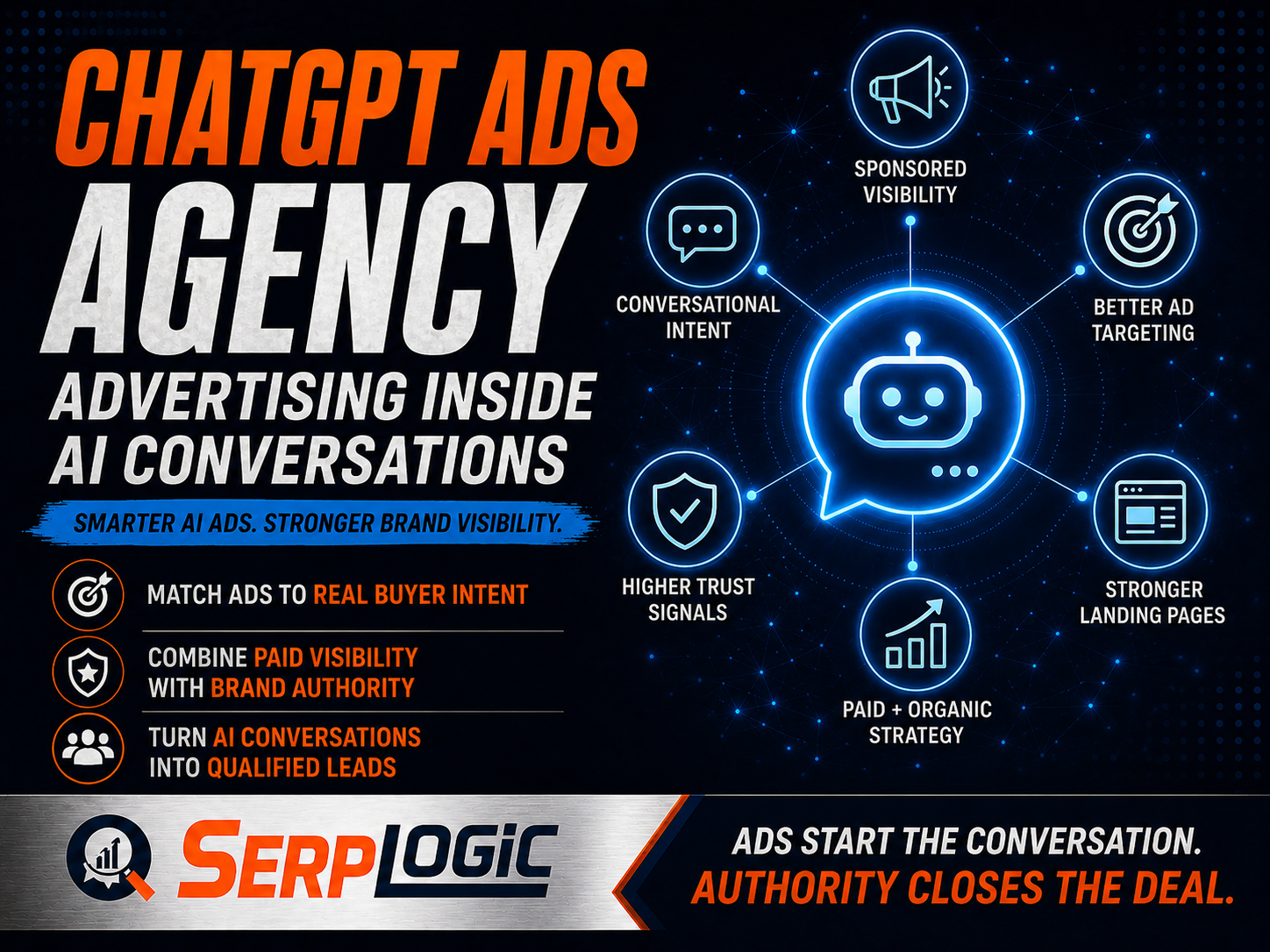
ChatGPT ads are here, which means the marketing industry has immediately started behaving normally.
By “normally”, we mean wildly overpromising, inventing new acronyms, and pretending every agency now has a secret playbook for dominating AI advertising.
Lovely.
Let’s get this straight from the start.
A ChatGPT ads agency should not just be a Google Ads agency with a new landing page and “AI” slapped into the headline.
Advertising inside AI conversations is different.
People are not scrolling a feed. They are not casually watching videos. They are not always typing obvious buying keywords into Google.
They are asking questions, comparing options, researching problems, exploring ideas and trying to make better decisions.
That makes ChatGPT ads interesting.
It also makes them easy to mess up.
Because if you treat them like another place to shout “book a demo” at someone who is still figuring out the problem, you will probably burn money and then blame the channel.
Classic.
A proper ChatGPT ads strategy needs to understand conversational intent, offer matching, landing pages, tracking, brand trust and the wider AI search visibility picture.
The ad gets you seen.
The strategy decides whether anyone cares.
What Is a ChatGPT Ads Agency?
A ChatGPT ads agency helps businesses plan, create, launch, manage and optimise advertising campaigns inside ChatGPT’s ad environment.
In plain English, it helps brands show up as sponsored placements when users are having relevant conversations inside ChatGPT.
But a good agency should not stop at campaign setup.
That is the easy bit.
A proper ChatGPT ads agency should understand:
- conversational intent
- AI search behaviour
- ad messaging
- landing page strategy
- conversion tracking
- offer positioning
- funnel design
- entity SEO
- brand authority
- AI search optimization
- content visibility
- digital PR
- brand mentions
- paid and organic search overlap
Because ChatGPT ads do not exist in a vacuum.
A user can see your ad, ask another question, compare you with competitors, search your brand, check reviews, look for third-party mentions and then decide whether you look credible.
That means your paid strategy and your authority strategy need to work together.
If they do not, the ad may simply expose the fact your brand looks weak online.
Why ChatGPT Ads Are Different From Google Ads
Google Ads are largely built around keywords.
Someone searches “best CRM for small business”, and advertisers bid to appear.
That model is familiar.
ChatGPT ads are different because the user’s intent may develop across a conversation.
A user might start with:
“How do I organise leads for my agency?”
Then ask:
“What tools do I need?”
Then:
“What is the best CRM if I use email outreach?”
Then:
“How does HubSpot compare to GoHighLevel?”
Then:
“What should I use if I want SMS follow-up and pipeline automation?”
That is not one keyword.
That is a decision journey.
A ChatGPT ads agency needs to understand the difference between keyword intent and conversational intent.
In Google Ads, the query is often the signal.
In ChatGPT, the conversation is the signal.
That changes the campaign strategy.
It changes the creative.
It changes the landing page.
It changes the measurement.
And it definitely changes how you should think about trust.
ChatGPT Ads Are Not Organic AI SEO
This matters.
Paid ChatGPT ads are separate from organic AI visibility.
You cannot simply pay to make ChatGPT organically recommend your brand inside normal answers. Sponsored placements are ads. Organic AI search visibility is a different thing.
That means brands need to think in two layers.
Paid AI visibility
This is where ChatGPT ads come in. You pay for sponsored visibility in relevant ChatGPT contexts.
Organic AI visibility
This is where AI SEO, generative engine optimization, brand mentions, content strategy, topical authority, digital PR and link building outreach come in.
Both matter.
But they are not the same.
A serious ChatGPT ads agency should explain this clearly.
If an agency tells you ChatGPT ads will magically make the model recommend your business organically, that is your cue to leave the call.
Preferably before they show you the “exclusive AI visibility framework” slide.
Why Brands Are Interested in ChatGPT Advertising
The appeal is obvious.
ChatGPT sits inside the research and decision-making process.
People use it to ask things like:
- “What is the best software for this?”
- “Which agency should I hire?”
- “How do I compare these options?”
- “What should I avoid?”
- “Which product is right for me?”
- “What is the cheapest reliable solution?”
- “What are the best alternatives?”
- “How much should I pay for this?”
- “What questions should I ask before buying?”
That is valuable territory.
In normal advertising, you are often trying to interrupt.
In ChatGPT advertising, the opportunity is to appear while someone is actively exploring a problem.
That can be powerful.
But only if the ad fits the conversation.
If the user is in research mode, help them understand.
If they are comparing options, help them compare.
If they are close to taking action, reduce friction.
If your ad and offer are mismatched to the user’s stage of awareness, you will get attention without useful intent.
That is expensive noise.
What We Would Test First for a ChatGPT Ads Campaign
This is where a lot of agencies will get lazy.
They will send everyone to the homepage, run one generic ad angle, report clicks and call it a test.
That is not a proper test.
If we were planning a ChatGPT ads campaign for a SaaS client, for example, we would not start with one landing page and hope. We would build the test around intent stages.
Problem-aware traffic
This user knows they have a problem but may not know the solution yet.
Example:
“How do I stop leads falling through the cracks?”
The offer should probably be educational:
- checklist
- guide
- audit
- calculator
- workflow template
- diagnostic tool
Sending this person straight to a hard demo page may be too early.
Comparison-stage traffic
This user is comparing tools, agencies or solutions.
Example:
“HubSpot vs GoHighLevel for agencies”
This user needs:
- comparison page
- pricing explainer
- pros and cons
- feature breakdown
- competitor alternative page
- case study
- implementation guide
They are not looking for vague brand poetry.
They want decision support.
Ready-to-buy traffic
This user is close to action.
Example:
“Best CRM consultant to set up GoHighLevel”
This is where a demo, call booking, trial, audit or consultation can make sense.
But even here, the landing page needs proof.
Case studies. Reviews. Clear offer. Process. Pricing guidance. Specificity.
Not a generic “we help businesses grow” page.
Nobody needs another one of those.
A 30–90 Day ChatGPT Ads Testing Plan
Early-stage ad channels are messy.
The first winners are usually not the people expecting perfect attribution from day one. They are the people who can test quickly, measure downstream quality and improve the wider brand footprint while the channel matures.
Here is how we would think about the first 90 days.
Days 1–30: Positioning, Tracking and First Tests
Before spending properly, get the foundations in place.
That means:
- define the main use cases
- map likely conversational intent
- build 2–3 landing page paths
- create ad angles for different awareness stages
- set up conversion tracking
- tag leads correctly in the CRM
- check brand search results
- review current AI search visibility
- audit competitor mentions
- make sure the landing pages are not embarrassing
The goal in month one is not to declare victory.
The goal is to find early signs of where useful demand exists.
Days 31–60: Cut Waste and Improve the Funnel
Once data starts coming in, the job is to separate curiosity from commercial value.
Look at:
- which ad angles drive qualified leads
- which landing pages hold attention
- which conversations produce better demos
- which users bounce quickly
- which campaigns create branded search lift
- which leads progress in the CRM
- which objections appear repeatedly
- which comparison pages users visit after clicking
This is where lazy reporting falls apart.
Clicks are not enough.
Cheap leads are not enough.
You need to know whether the campaign is creating pipeline.
Days 61–90: Scale What Produces Quality
By month three, you should have a better idea of what deserves more budget.
Then you can:
- scale winning intent paths
- build more landing pages
- refine ad messaging
- create better comparison assets
- add retargeting audiences where possible
- strengthen brand proof
- build supporting content
- earn more relevant third-party mentions
- align paid campaigns with AI SEO and digital PR
The point is not just to make the ads better.
The point is to make the whole journey stronger.
That is how a new paid channel becomes an actual growth asset instead of a novelty budget.
What a ChatGPT Ads Agency Should Actually Do
A proper ChatGPT ads agency should do more than create campaigns and send screenshots of a dashboard.
The useful work starts before the ad goes live.
Map Conversational Intent
The agency should think beyond keywords.
For example, a B2B SaaS brand should not only target “CRM software”.
It should map conversational scenarios like:
- “I need a CRM for a small agency.”
- “I want to automate lead follow-up.”
- “I need something cheaper than HubSpot.”
- “I want a CRM that works with email and SMS.”
- “I need to manage leads from Facebook ads.”
- “I need a CRM my sales team will actually use.”
- “What should I ask before choosing a CRM?”
Each of those suggests a different angle.
Different pain.
Different offer.
Different landing page.
Match Offers to User Intent
One offer will not fit every conversation.
Research-stage users may need:
- guides
- checklists
- calculators
- explainers
- templates
- comparison resources
Comparison-stage users may need:
- alternative pages
- competitor comparisons
- pricing explainers
- case studies
- buyer guides
- objection handling
Decision-stage users may need:
- demos
- audits
- consultations
- free trials
- onboarding calls
- implementation plans
The mistake is treating every user like they are ready to buy now.
Some are.
Many are not.
Good advertising meets them where they are.
Fix the Landing Page Before Spending Money
A ChatGPT ad can only do so much.
If your landing page is vague, slow, confusing or generic, the campaign will suffer.
A strong landing page should make it obvious:
- what the offer is
- who it is for
- what problem it solves
- why the brand is credible
- what proof supports the claim
- what happens next
- why this option is better than alternatives
This is especially important with AI-driven traffic.
Users may arrive with more context and higher expectations because they have just been researching inside a conversational tool.
Do not send them to a page that says:
“We provide innovative solutions for modern businesses.”
Say what you do.
Show proof.
Make the next step obvious.
Build Measurement Beyond the Initial Click
This is where a lot of paid campaigns get misread.
A click is not a customer.
A lead is not revenue.
A demo booking is not a closed deal.
A serious ChatGPT ads agency should help track:
- initial click
- landing page engagement
- form submissions
- demo bookings
- lead quality
- CRM progression
- sales-qualified leads
- pipeline value
- close rate
- assisted conversions
- branded search lift
- post-click brand searches
- retargeting audience growth
- content engagement after click
- comparison-page visits
- return visits
This matters because early AI ad traffic may behave differently from standard PPC traffic.
Some users may research more after clicking.
Some may ask ChatGPT about the brand.
Some may Google the company.
Some may come back later through branded search.
If you only measure last-click conversions, you may miss part of the value.
If you only measure clicks, you may fool yourself entirely.
Use AI SEO Alongside ChatGPT Ads
Paid ChatGPT ads can help you appear in sponsored placements.
AI SEO helps your brand become more visible organically across AI-powered search environments.
That includes:
- ChatGPT search visibility
- Perplexity visibility
- Google AI Overviews
- Gemini
- Claude
- AI-driven search experiences
The work includes:
- content optimization
- entity SEO
- brand mentions
- topical authority
- digital PR
- link building
- trusted third-party validation
Why does this matter?
Because users do not always trust ads on their own.
They may see your ad, then ask ChatGPT about your brand. They may search Google. They may compare you with competitors. They may look for reviews, mentions, list placements and proof.
If your wider footprint is weak, paid visibility can expose that weakness.
If your wider footprint is strong, paid visibility works harder.
This is where SerpLogic sees the real opportunity. ChatGPT ads are one layer. The bigger opportunity is combining paid AI visibility with authority building, brand mentions, digital PR, links and content that makes the brand easier to trust across the wider web.
What Makes ChatGPT Ads a Good Fit?
ChatGPT ads will not be right for every business on day one.
They are likely to be most interesting for brands with:
- clear offers
- strong margins
- comparison-led buying journeys
- useful educational content
- strong landing pages
- good brand positioning
- buyer intent that develops through research
- ability to track and optimise campaigns
- sales teams that can handle consultative leads
Good fits may include:
- SaaS companies
- ecommerce brands
- finance brands
- education providers
- B2B services
- agencies
- software tools
- lead generation businesses
- health and wellness brands
- high-consideration products
The stronger the research process before purchase, the more interesting ChatGPT ads become.
If customers need to compare, understand, shortlist or ask questions before buying, conversational advertising could become very valuable.
ChatGPT Ads for SaaS Companies
SaaS is an obvious fit.
People use AI tools to compare software, research features, build workflows and understand alternatives.
A SaaS company could use ChatGPT ads to target users exploring:
- best tools for a problem
- software comparisons
- alternatives to a competitor
- workflow automation
- pricing questions
- implementation concerns
- integration needs
But the ad is only one part of the journey.
The SaaS company also needs:
- comparison pages
- use-case pages
- onboarding content
- case studies
- reviews
- third-party list placements
- digital PR mentions
- strong product positioning
If someone sees the ad and then asks, “Is this tool any good?”, the wider web needs to help answer that.
ChatGPT Ads for Ecommerce Brands
Ecommerce brands should pay attention too.
People ask ChatGPT for buying advice.
They ask about:
- best products
- gift ideas
- product comparisons
- sizing
- alternatives
- ingredients
- use cases
- pros and cons
- what to avoid
That creates ad opportunities.
But again, the basics matter.
An ecommerce brand running ChatGPT ads should have:
- strong product pages
- clear product data
- buying guides
- comparison content
- reviews
- product roundups
- relevant mentions
- useful FAQs
- fast checkout
The ad may introduce the product.
The rest of the footprint helps close the trust gap.
ChatGPT Ads for Agencies and Service Businesses
Service businesses should be careful but interested.
People absolutely use AI tools to research agencies, consultants and service providers.
They ask:
- “Who are the best agencies for this?”
- “What should I look for in a provider?”
- “How much should this cost?”
- “What questions should I ask before hiring?”
- “Compare agency vs freelancer.”
- “Best companies for [service].”
That creates opportunity.
But service businesses need proof.
A ChatGPT ad promoting an agency with no case studies, no third-party mentions, no clear positioning and a weak website is not going to perform miracles.
Agencies need:
- strong service pages
- case studies
- proof
- reviews
- comparison content
- founder credibility
- niche positioning
- external mentions
- digital PR
- authority links
Paid visibility gets you seen.
Authority gets you trusted.
Questions to Ask Before Hiring a ChatGPT Ads Agency
If you are hiring a ChatGPT ads agency, do not just ask whether they can run the ads.
That is the minimum.
Ask better questions.
How will you map conversational intent?
If they only talk about keywords, that is a red flag.
They should be thinking about user journeys, research stages, objections and comparison behaviour.
What landing pages will you send traffic to?
If the answer is “your homepage”, be suspicious.
Good campaigns need landing pages matched to intent.
How will you separate paid ChatGPT performance from organic AI visibility?
A proper agency should understand the difference between sponsored placements and organic AI search visibility.
If they blur the two together, that is a problem.
What will you test in the first 30–60 days?
They should be able to explain initial testing clearly.
Ad angles. Landing pages. offers. Tracking. Lead quality. CRM outcomes.
Not just “we will optimise performance”.
That phrase has hidden a lot of sins.
How will you measure lead quality beyond the click?
If the agency only reports impressions, clicks and form fills, the measurement is too shallow.
You need downstream quality.
Can you support authority building?
This is where many paid agencies fall short.
ChatGPT ads can create visibility, but links, mentions, content and digital PR help build trust around the brand.
A better agency understands both.
What should we fix before launching?
This is one of the best questions.
A strong agency will tell you if your landing page, offer, tracking or brand proof is not ready.
A weak agency will take the budget and hope.
Common ChatGPT Ads Mistakes
Treating ChatGPT Ads Like Google Ads
There will be overlap, but the behaviour is different.
Google Ads are query-led.
ChatGPT ads are conversation-led.
The messaging, offer and landing page need to reflect that.
Sending Traffic to Weak Pages
If your landing page says nothing clearly, the ad will not save it.
Fix the page first.
Ignoring Organic AI Visibility
Paid ChatGPT ads do not replace AI SEO.
You still need organic visibility, brand mentions, content, links and authority.
Overpromising What Ads Can Do
ChatGPT ads can create paid visibility.
They do not guarantee organic recommendations, AI citations or instant trust.
Any agency pretending otherwise is being slippery.
Judging the Channel Too Early
Early tests can be noisy.
Do not declare failure after a tiny sample.
But do not keep spending blindly either.
Set a test budget, define the learning goals, track quality and adjust properly.
Forgetting the Sales Team
If the sales team does not know where the lead came from, what intent stage they may be at, or what content they engaged with, the handoff gets weaker.
For B2B and high-ticket offers, paid media and sales need to talk.
Radical idea, apparently.
How SerpLogic Can Help
SerpLogic helps brands build the authority layer around AI search visibility.
That includes:
- digital PR
- link building
- guest posts
- brand mentions
- authority building
- topical relevance
- AI search visibility campaigns
- content strategy support
For brands exploring ChatGPT ads, that matters because paid visibility works best when the wider trust footprint is strong.
An ad can introduce you.
Your authority convinces people you are worth taking seriously.
If your brand is invisible across the web, AI-driven advertising may expose that.
If your brand is supported by useful content, links, mentions, reviews and digital PR coverage, you are in a far stronger position.
Final Word: ChatGPT Ads Are an Opportunity, Not a Shortcut
ChatGPT ads could become a serious advertising channel.
The intent is rich. The context is valuable. The user is often already researching, comparing or deciding.
But this is not a shortcut around brand building.
The businesses that win will be the ones that understand both sides of the equation:
Paid visibility inside AI conversations.
And organic authority across the wider web.
That means better offers, better landing pages, better content, stronger mentions, relevant links, clearer positioning and measurement that looks beyond cheap clicks.
ChatGPT ads may get you into the conversation.
Authority helps you belong there.
FAQs
What is a ChatGPT ads agency?
A ChatGPT ads agency helps businesses create, manage and optimise advertising campaigns inside ChatGPT’s ad environment. A good agency should also understand conversational intent, landing pages, tracking, AI search visibility and brand authority.
Are ChatGPT ads the same as Google Ads?
No. Google Ads are largely keyword-led. ChatGPT ads are more conversation-led, meaning user intent may develop across a longer interaction. That changes messaging, targeting, landing pages and measurement.
Can ChatGPT ads make ChatGPT recommend my brand organically?
No. Paid ads are separate from organic AI answers. ChatGPT ads can provide sponsored visibility, but they do not guarantee organic recommendations or citations.
Who should use ChatGPT ads?
ChatGPT ads may be useful for SaaS companies, ecommerce brands, agencies, lead generation businesses and other brands with research-heavy buying journeys. They are especially interesting where users compare options before buying.
What should a ChatGPT ads agency do?
A good ChatGPT ads agency should help with campaign setup, conversational intent mapping, messaging, landing pages, tracking, offer strategy and optimisation. Ideally, it should also understand AI SEO and brand authority.
Do I need AI SEO if I am running ChatGPT ads?
Yes, ideally. Paid ads can help you appear as a sponsored placement, but AI SEO helps build organic visibility and trust across AI search environments. The two work best together.
How do brand mentions help ChatGPT advertising?
Brand mentions help strengthen your wider authority footprint. If users see your ad and then research your brand, relevant third-party mentions can help build trust.
Do links matter for ChatGPT ads?
Links may not directly affect the ad placement itself, but they support wider search authority, rankings, brand trust and AI search visibility. That can improve the overall journey around your advertising.
What landing page works best for ChatGPT ads?
The best landing page depends on the user intent. Research-stage users may need guides or comparisons. Decision-stage users may need demos, trials, consultations or clear product pages. Generic homepages are usually weak.
How should ChatGPT ads be measured?
Measure beyond clicks. Track landing page engagement, demo quality, CRM progression, pipeline, assisted conversions, branded search lift, comparison-page visits and closed revenue where possible.
Is now a good time to test ChatGPT ads?
Yes, for the right brands. Early channels often reward businesses that test before costs mature. But you still need proper tracking, strong messaging, good landing pages and realistic expectations.
What should I ask before hiring a ChatGPT ads agency?
Ask how they map conversational intent, what landing pages they will use, how they measure lead quality, what they will test in the first 30–60 days, and whether they understand the difference between paid ChatGPT ads and organic AI visibility.
